Author: Eddie Thuma

  • Exact Next Move Beats Status Comfort

    A lot of work does not stall because nobody cares.

    It stalls because the team stopped at status.

    The update exists.
    The owner was mentioned.
    The blocker was acknowledged.
    The recap sounds intelligent.

    But when the task comes back into focus, someone still has to ask the same question:

    what, exactly, happens next?

    That question is where a surprising amount of operator drag hides.

    Most teams assume they have a prioritization problem when they really have a next-move problem.

    They know the project matters.
    They know the work is still open.
    They know roughly what needs to happen.

    What they have not done is reduce the situation to one executable move with a clear owner and a visible starting point.

    So the work lingers in a strange half-state.

    It has enough language around it to feel managed.
    It does not have enough specificity to move.

    That is what I mean by status comfort.

    Status comfort is the false sense of progress you get from having a decent update attached to a task that is still operationally fuzzy.

    The team feels informed.
    The system looks organized.
    The task sounds alive.

    But the lane is still parked.

    This matters more now because AI is making status generation almost free.

    You can get a crisp summary in seconds.
    You can compress a long thread into a neat recap.
    You can turn messy motion into polished language fast enough to calm the room.

    That is useful.

    It is also dangerous if you start confusing a clean summary with an executable handoff.

    AI can make ambiguity sound structured.
    It cannot remove ambiguity unless the system asks it to.

    That is why I think a lot of modern operators do not need more dashboards first.
    They need stricter next-move discipline.

    The real tax is not only unfinished work.
    It is work that keeps resurfacing with enough status to sound managed, but not enough specificity to restart cleanly.

    That is when the founder becomes the router.

    Not because the founder is the only smart person in the room.
    Because the founder is still the only one willing or able to translate vague status into concrete motion.

    That translation work is exhausting.
    It fragments attention.
    It slows the queue.
    It quietly makes every system look more delegated than it really is.

    If you want cleaner execution, faster re-entry, and lower coordination drag, use a four-part next-move framework.

    ### 1. Replace the intention with one concrete action

    A lot of stalled work is written as an intention instead of an action.

    It sounds like this:

    – follow up soon
    – revisit after approval
    – send the updated version
    – check with the client
    – circle back next week

    None of those are real next moves yet.

    They point in the direction of motion without making motion executable.

    A concrete next move usually starts with a verb and ends with a visible object:

    – send version three to the client
    – verify the live post returns `200`
    – ask legal to approve the final paragraph
    – reply to the invoice thread with the corrected attachment

    That level of specificity matters because it removes re-entry friction.

    The task does not need to be interpreted again.
    It only needs to be done.

    ### 2. Name the owner instead of implying one

    Teams lose a lot of speed in the gap between “someone should” and “Alex owns this now.”

    Implied ownership is one of the easiest ways to create the illusion of coordination without the reality of it.

    The task has context.
    The team had the conversation.
    Everybody assumes the right person understands the assignment.

    Then the lane cools off because nobody actually inherited the move.

    Clear ownership is not bureaucracy.
    It is the handoff mechanism that lets the work leave discussion mode.

    If the next move matters, the owner should be explicit.

    Not:

    – this probably goes to marketing
    – ops should handle it
    – engineering can pick this up

    But:

    – Jackie sends the revised brief
    – Kareem verifies the workflow and updates the record
    – Eddie publishes the post and saves the live URL

    When the owner is named, accountability gets lighter, not heavier.
    The system stops depending on ambient awareness.

    ### 3. Leave the visible resume point

    This is the field many teams skip even when they get the action and owner right.

    They know what should happen next, but they do not leave behind where the next person should resume.

    Now the work has a destination but not an on-ramp.

    That means the next operator still has to ask:

    where do I start?
    which file is current?
    which link is real?
    which draft are we using?
    which thread contains the actual blocker?

    That is wasted energy.

    A visible resume point can be simple:

    – start from `tasks/eddie-weekly-issue-2026-09-03-exact-next-move.md`
    – use the draft in the current editor session
    – reply inside the existing approval thread
    – resume from the saved task file and the last blocker note

    Good systems preserve not just the next action, but the exact place where action begins.

    Without that, the queue stays expensive to restart.

    ### 4. Log the fallback before the lane goes cold

    This is where operational maturity starts separating itself from optimism.

    Most teams log the happy path and improvise the recovery path later.

    That works until the first path fails.

    Then the task drops into vague language:

    – blocked for now
    – waiting on a fix
    – will retry later
    – need another route

    That is how work goes cold.

    A better handoff leaves the fallback while the context is still fresh:

    – if the API call fails, update the local draft artifact and log the exact response
    – if approval does not arrive, park the lane with the blocker and resume condition
    – if publish is rejected, keep the canonical copy local and store the exact write-path failure

    Fallbacks protect momentum because they turn failure into the next move instead of a future mystery.

    That is the real upgrade.

    The point is not to predict every problem.
    The point is to stop forcing the next person to invent recovery from scratch.

    ### Why this matters for AI-heavy teams

    AI is going to magnify the quality of your handoffs.

    If your team already writes crisp next moves, clear owners, visible resume points, and explicit fallbacks, AI will make those systems faster.

    If your team mainly produces elegant status language, AI will make the weakness easier to hide.

    That is the trap.

    The notes get better.
    The summaries get smoother.
    The updates sound more complete.

    And yet the founder still has to step in and translate ambiguity into motion by hand.

    That is not leverage.

    Leverage is when the work can move without a human router decoding it again.

    So if your queue feels heavier than it should, do not only ask whether the team knows the status.

    Ask whether the next move is executable.

    Ask whether the owner is named.
    Ask whether the resume point is visible.
    Ask whether the fallback exists before the first path breaks.

    Status is useful.
    Status is necessary.

    But status is not execution.

    Execution starts when the work is reduced to a move that somebody can actually make from a place they can actually find.

    That is why exact next move beats status comfort.

    It lowers ambiguity tax.
    It cuts founder routing drag.
    It makes AI more useful.
    And it turns a thoughtful system into a moving one.

    Reply or email Eddie for a workflow sprint.
  • Saved State Beats Founder Reload

    A lot of work feels harder than it should because it does not restart from reality.

    It restarts from memory.

    The task was discussed.

    The AI summary was written.

    The blocker was mentioned.

    The owner thinks the next move was obvious.

    Then the work comes back two days later and somebody has to rebuild the whole situation from scratch.

    What already happened here?

    What failed?

    What is still true?

    What is the actual next move?

    Where does this resume from?

    When those questions keep reappearing, the business is paying a hidden tax.

    I call it founder reload.

    This is the moment when the founder, or the most context-loaded operator on the team, becomes the human process memory. They are not only doing the next decision. They are reconstructing prior state because the system did not save it cleanly enough for anyone else to resume.

    That is more expensive than most teams admit.

    They notice missed follow-ups.

    They notice stalled tasks.

    They notice tasks reopening with extra confusion.

    What they often miss is the deeper pattern:

    the work is not just unfinished.

    the work is resumable only through somebody's head.

    That means every interruption makes it heavier.

    This matters even more now because AI can make motion sound coherent without making it resumable.

    You can generate a beautiful recap.

    You can get a polished status note.

    You can compress five messy threads into one neat summary.

    That is useful.

    But a clean recap is not the same thing as a clean state.

    If the recap does not leave behind what the next operator needs to continue, then all you did was improve the narration layer. The operating layer is still thin.

    That is why I think more teams need a saved-state discipline before they add another layer of automation.

    The real operator tax is not only unfinished work.

    It is work that has to be mentally rebuilt every time it returns.

    Restart cost is real cost.

    You see it when a task keeps getting slower after interruptions.

    You see it when the same blocker has to be explained again.

    You see it when a founder says, "I know we talked about this, but let me reconstruct what happened."

    You see it when the team has the conversation history but still cannot resume the lane quickly.

    If you want work to feel lighter, faster, and more trustworthy, save state in a way that makes re-entry cheap.

    Here is the four-part framework I would use.

    1. Capture what already happened

    The first problem in most restart-heavy systems is that prior motion exists, but not in a reusable form.

    People remember the shape of the work, but not the exact state.

    Maybe the update says a proposal was drafted.

    Maybe the thread says a client replied.

    Maybe the board shows the task moved once.

    That is not enough if the next person still has to infer the real situation.

    A resumable lane should make prior state obvious:

    • what was completed
    • what changed last
    • what was attempted
    • what result that attempt produced

    This should not live only in a meeting memory, a chat fragment, or a verbal handoff.

    If prior state is thin, every restart becomes detective work.

    2. Log the current blocker or live risk

    A lot of teams are willing to log success, but they are surprisingly vague about active friction.

    They write things like:

    • waiting on this
    • ran into an issue
    • still in progress
    • needs follow-up

    That language protects ambiguity.

    It does not protect resumability.

    A useful blocker log says what is actually wrong now.

    • the site login worked, but publish returned a 403
    • legal approved version two, not version three
    • payment failed and is waiting on owner approval
    • the file shipped, but the client record was never updated

    That kind of logging matters because the next operator does not have to reverse-engineer the failure.

    They can see the live constraint immediately.

    3. Leave the exact next move visible

    This is the field I see missing most often.

    Teams often preserve context well enough to describe the situation, but not well enough to remove the decision friction of re-entry.

    Everybody knows the lane is open.

    Nobody knows the exact next step.

    Now the founder gets pulled back in.

    Not because the founder is the only person capable of doing the work, but because the system did not leave behind a precise resume point.

    The best saved-state systems make the next move explicit:

    • send the revised draft to the client
    • confirm the public URL returns 200
    • wait for approval from the owner
    • retry the publish path with the fresh nonce

    That does two things.

    It lowers restart time.

    It lowers coordination stress.

    The task does not need to be rediscovered.

    It only needs to be resumed.

    4. Store the proof surface or destination

    Saved state is not complete if it tells you what happened but not where reality lives.

    The post may be published, but where is the URL?

    The file may be exported, but where is the file?

    The record may be updated, but where is the system of record?

    Without a visible proof surface, the business still depends on memory at the moment verification matters.

    That is why the last step is not just "mark done."

    It is:

    • save the live URL
    • save the updated record
    • save the sent thread
    • save the artifact destination

    When those surfaces are visible, work stops boomeranging back as often.

    The system can re-enter from proof, not from recollection.

    Why this matters for AI-heavy teams

    AI is going to amplify whichever operating discipline already exists.

    If your system already saves usable state, AI makes capture, summarization, and handoffs faster.

    If your system does not save usable state, AI makes the gaps easier to hide.

    That is the danger.

    The team sounds organized.

    The notes look polished.

    The summaries are strong.

    But the founder still acts as the reload function.

    That is not scale.

    Scale is when the system can survive interruption without dragging one person's memory back into the loop every time.

    So before you chase more automation, audit your restart cost.

    Look for the lanes where work feels heavier each time it resurfaces.

    Look for the places where the recap exists but the current state is still scattered.

    Look for the tasks where the next move disappears after a pause.

    Look for the places where one person quietly carries the truth between work cycles.

    If work cannot be resumed cleanly, it is not under control.

    Saved state beats founder reload because saved state turns progress into something reusable.

    It reduces re-entry cost.

    It lowers confusion.

    It protects momentum.

    It gives AI something real to work with instead of forcing it to summarize a broken handoff.

    And most importantly, it lets the founder think forward instead of reconstructing the past.

    Reply or email Eddie for a workflow sprint.

  • Proof Surfaces Beat Verbal Closure

    Teams do not get lighter when they talk clearly about completed work.

    They get lighter when completion leaves behind a proof surface.

    That sounds obvious until you watch how much modern work is “closed” through language alone.

    The meeting recap says it shipped.

    The Slack thread says it was handled.

    The AI summary says the blocker was resolved.

    The handoff note says everything is on track.

    Then somebody needs the evidence later and the room gets quiet.

    Where is the live URL?

    Where is the saved file?

    Where is the updated system record?

    Where is the blocker note if the path failed?

    That gap is where a lot of operator stress hides.

    The problem is not always unfinished work. The problem is work that sounds finished before the proof surface exists.

    This matters more now because AI is getting very good at compressing motion into clean language. It can write a polished update faster than most teams can verify the underlying state. It can make a messy process sound coherent. It can give the nervous system a temporary feeling of closure without producing the artifact that real closure requires.

    That is useful if you understand the limitation.

    It is expensive if you start treating the summary as the proof.

    AI can summarize motion beautifully.

    It cannot manufacture evidence.

    That is why I think a lot of teams need a proof discipline upgrade more than another layer of automation.

    If your business keeps reopening the same tasks, the drag may not be speed. The drag may be that completion has no durable surface.

    The founder heard that it was done, so the founder carries it mentally.

    The operator thinks it is done, so the operator stops checking.

    The team assumes it is done, so nobody logs the failure path.

    Then the work boomerangs back with extra confusion because the system cannot verify what actually happened.

    That is not a communication issue alone.

    It is an evidence architecture issue.

    If you want cleaner execution, calmer operators, and fewer boomerang tasks, use a four-part proof framework.

    1. Define the artifact that proves the step happened

    Do this before the work starts, not after somebody asks for evidence.

    If the task is “publish the post,” the proof might be the live URL.

    If the task is “send the proposal,” the proof might be the sent email thread.

    If the task is “update the client record,” the proof might be the changed CRM entry with the new timestamp.

    If the task is “ship the report,” the proof might be the saved file in the agreed folder plus the sent delivery note.

    The point is simple: if nobody knows what counts as proof, teams default to vibe-based completion.

    Vibe-based completion feels fast in the moment.

    It becomes expensive on retrieval.

    2. Save the live link, receipt, or record where the team will actually look later

    This is where a lot of decent teams still fail.

    The artifact exists, but it lives in the wrong place.

    Someone did publish the page, but the task card has no URL.

    Someone did send the invoice, but the client record was never updated.

    Someone did export the file, but it sits on a desktop with no reference in the project thread.

    That means the work is partially complete and operationally noisy.

    Proof does not help much if retrieval still depends on memory, detective work, or asking the same person again.

    A trustworthy system does not just create the artifact.

    It stores the proof surface where the next operator expects to find it.

    That is what makes completion reusable instead of personal.

    3. Update the system of record when the state changes

    A lot of teams confuse the communication layer with the operating layer.

    They send the update.

    They mention the result.

    They drop the screenshot.

    But the board, CRM, tracker, or workflow record still says the old thing.

    Now the business has two realities:

    • the narrated reality
    • the recorded reality

    Whenever those split, the founder becomes the reconciliation layer.

    That is one of the quietest ways to build hidden workload.

    The founder remembers the “real” status.

    The team sees the stale record.

    The next move gets delayed because nobody trusts the system completely.

    Good operators close that gap fast.

    If the state changed, the record changes.

    If the post went live, save the URL and mark it published.

    If the approval failed, mark it blocked and say why.

    If the asset shipped, move the task and log the evidence.

    The record should not need translation from someone’s memory.

    4. Log the blocker and next path when completion fails

    This is the discipline that keeps a failed step from becoming future confusion.

    When something does not ship, most teams still leave behind weak residue:

    • ran into an issue
    • got blocked
    • needs follow-up
    • still in progress

    That language preserves ambiguity.

    A better system logs the actual blocker and the next path:

    • `WordPress login worked, but post creation returned a 403`
    • `Payment method failed; waiting on owner approval`
    • `File exported successfully; client delivery blocked because legal has not approved version three`

    Now the next person does not have to reconstruct the failure from fragments.

    They can see what happened, what did not happen, and what the next recovery step should be.

    That is how proof discipline reduces repeat confusion.

    Not by pretending everything closes cleanly, but by making even failed motion legible.

    Why this matters for AI-heavy teams

    AI amplifies both sides of the game.

    Used well, it can make status capture, summaries, and handoffs dramatically faster.

    Used lazily, it can make incomplete reality sound more settled than it is.

    That is the danger.

    An elegant summary is not the same as a reliable finish surface.

    If your team starts treating AI narration as evidence, you get prettier confusion. The business sounds organized while the founder still carries the recovery map in his head.

    That is not scale.

    Scale happens when the system can verify reality without dragging one person’s memory back into the loop every time.

    That means:

    • define the artifact
    • save the proof where retrieval is obvious
    • update the actual record
    • log the blocker and next path when the step breaks

    Spoken closure is not operational closure.

    Operational closure is what remains true after the meeting ends, the chat scrolls away, and the founder is no longer in the room to explain what really happened.

    If you want lighter operations, do not just improve the update.

    Improve the proof surface.

    Reply or email Eddie for a workflow sprint.

  • Review Rhythm Beats Silent Drift

    Most operators do not get hurt by one dramatic failure. They get taxed by stale work, aged blockers, and assumptions nobody reviewed soon enough.

    Most businesses do not lose momentum in one dramatic moment.

    They drift.

    A task still says active even though nobody touched it in nine days. A follow-up stays in somebody’s head instead of on a live review surface. A blocker keeps waiting for magic because nobody chose a reroute. A standard changed two weeks ago, but the workflow is still operating on the old version.

    Nothing looks catastrophic.

    That is exactly why it becomes expensive.

    Operators love to talk about intensity, execution speed, and output volume. In AI-heavy systems, that bias gets even stronger. More drafts. More automations. More notifications. More motion.

    But motion is not the same thing as alignment.

    You can absolutely build a busy system that keeps drifting quietly out of spec.

    That is the real tax I see in a lot of founder-led businesses right now.

    Not a lack of tools. Not a lack of ambition. Not even a lack of effort.

    It is a lack of review rhythm.

    Without review rhythm, stale work accumulates faster than people realize. The founder becomes the backup memory system. Open loops stay open because nobody forced a decision. Blockers become normal because nobody reviewed them while change was still cheap. AI adds output on top of that, which makes the whole thing feel modern while the drift gets harder to see.

    This matters now because AI compresses the cost of producing the next thing.

    When production gets cheap, drift gets sneakier.

    You can generate the post, summarize the meeting, route the task, draft the outreach, and queue the asset in a fraction of the old time. That feels like leverage. Sometimes it is leverage. But if the review layer is weak, all you really did was accelerate the number of places where stale work can hide.

    That is why I think a lot of smart operators are solving the wrong problem.

    They keep asking:

    • Which tool should we add?
    • Which automation should we build?
    • Which prompt should we tighten?

    Useful questions. Wrong order.

    The better question is:

    What is the rhythm that keeps this system current, trustworthy, and low-drift?

    If that answer is fuzzy, more output just gives your drift better branding.

    The simplest fix I know is a four-part weekly review rhythm:

    1. active work review
    2. stale work cleanup
    3. blocker reroute
    4. assumption refresh

    It is not glamorous. That is why it works.

    1. Active work review

    First, review what claims to be active.

    Not what exists in theory. Not what people say they are working on. What is actually moving right now?

    This one step exposes a lot of illusion.

    Every business has tasks that look alive because the status never changed. They are still in progress. They still appear on a board. They still get mentioned in meetings. But the work is not advancing. Nobody owns the next move tightly enough. Nobody has proof that the task is genuinely moving. It just has the optics of movement.

    Active work review forces a cleaner question:

    If we checked this today, what evidence would prove it is truly active?

    If there is no evidence, the task is not active. It is aging in costume.

    That distinction matters because fake-active work contaminates everything around it. It distorts priorities, clutters reviews, hides real capacity, and trains teams to accept stale status as normal.

    2. Stale work cleanup

    Once you see what is actually active, clean up what is not.

    This is where most teams hesitate because closure feels emotionally heavier than addition. Starting something gives people energy. Closing, killing, or de-scoping something asks for honesty.

    But stale work is not neutral.

    Every stale task keeps charging rent:

    • cognitive rent because someone still carries it
    • workflow rent because it pollutes the live queue
    • trust rent because status stops meaning what it says

    If a task should be closed, close it. If it should be archived, archive it. If it still matters but has not advanced, rename the truth instead of preserving the fiction.

    That alone can change how a system feels.

    A lot of overload is not work overload. It is stale-loop overload.

    People are carrying too many items that no longer deserve active status. That creates background stress, weakens trust in the board, and pushes more responsibility back into the founder’s head.

    Stale work cleanup is not cosmetic. It is nervous-system maintenance for the business.

    3. Blocker reroute

    Next, review blocked work before the blocker gets old enough to become culture.

    This is the one that quietly kills momentum in a lot of teams.

    A task hits friction. Maybe it needs approval. Maybe a dependency failed. Maybe the owner changed. Maybe a login broke. Maybe an outside party stalled. Nobody decides the reroute, so the task just waits.

    Waiting is not always wrong.

    Unreviewed waiting is the problem.

    Once a blocker sits too long, people stop seeing it as a temporary state and start treating it like background weather. Then the workflow adapts around the blockage instead of resolving it.

    Good review rhythm asks:

    • What is blocked?
    • How long has it been blocked?
    • What was already tried?
    • What is the next safe reroute?
    • If we are not rerouting it, why is it still in an active lane?

    That is how you stop blockers from turning into quiet decay.

    The goal is not to eliminate every blocker. The goal is to prevent blocked work from aging invisibly.

    4. Assumption refresh

    Finally, refresh assumptions.

    This is where drift gets really expensive because assumption drift often looks intelligent right until it breaks something.

    A standard changed. A client expectation evolved. A credential rotated. A platform rule moved. A CTA is no longer the right one. A workflow that used to be safe now depends on a new failure point.

    But the team kept running the old version because nobody had a ritual for asking what changed.

    Assumption refresh is the discipline that keeps systems current instead of just busy.

    Ask simple questions:

    • What used to be true that may not be true now?
    • Which workflow still depends on memory instead of a current source of truth?
    • Which standard quietly changed without the system catching up?
    • Which recurring step deserves a rewrite because the context changed?

    This is especially important in AI-assisted operations.

    AI makes it easy to preserve a stale pattern at scale.

    If your prompts, automations, and checklists are built on assumptions nobody reviewed, you are not scaling intelligence. You are scaling drift.

    Why this beats more intensity

    The operators who compound are usually not the people with the loudest work ethic theater.

    They are the people whose systems stay current.

    They review active work before it goes stale. They clean up dead weight before it becomes ambient stress. They reroute blockers before delay becomes identity. They refresh assumptions before old standards keep running in a changed environment.

    That is what review rhythm does.

    It keeps the business honest.

    It lowers the amount of context the founder has to carry personally. It makes boards mean what they say. It shortens correction distance. It reduces the number of surprises that were visible earlier but nobody reviewed on purpose.

    Most businesses do not need more projects. They need a cleaner review rhythm.

    Before you add another tool, another automation, or another AI layer, ask whether your current system has a real cadence for catching drift.

    Because silent drift is expensive precisely because it does not announce itself.

    It just slowly turns active work into stale work, blockers into background noise, and founders into the emergency memory layer for everything the workflow failed to hold.

    That is why review rhythm beats silent drift.

    Not because review looks disciplined.

    Because disciplined review is how a modern system stays trustworthy.

    Reply or email Eddie for a workflow sprint.

  • Verification Beats Velocity Theater

    Most operators do not have a speed problem.

    They have a correction-distance problem.

    Work moves. Drafts appear. Automations fire. A post gets written in seconds. A report gets summarized before the coffee cools. A handoff that used to take a day now takes five minutes.

    That feels like progress.

    Sometimes it is.

    But a lot of teams are mistaking visible motion for trustworthy motion.

    The output is faster. The correction loop is still sloppy. So the business keeps paying the same tax in a more modern wrapper.

    The draft still has to be reopened. The automation still has to be checked by the founder. The follow-up still depends on someone remembering. The asset still has to be compared against what was actually promised. The system still ships uncertainty downstream and hopes somebody catches it later.

    That is not leverage.

    That is velocity theater.

    A system is not strong because it produces more work faster. A system is strong because the distance between action and proof is short.

    That is the real operator edge.

    Not maximum output. Minimum correction distance.

    The teams that compound are not the ones with the most tools. They are the ones where fewer things escape unchecked, fewer errors travel downstream, and fewer important tasks bounce back to the founder for rescue.

    This matters right now because AI makes the first move cheap.

    Cheap first moves are useful. They are also dangerous when they hide weak finishing systems.

    Once draft production, task routing, and automation get faster, every weakness in your verification layer becomes easier to ignore for a while and more expensive later.

    That is why so many smart operators feel like they are running modern systems but still living inside old stress.

    The stack changed. The trust architecture did not.

    The cleanest fix I know is a four-part proof loop:

    1. standard
    2. owner
    3. proof surface
    4. recovery path

    If those four parts are clear, faster systems actually help. If those four parts are weak, speed just creates a prettier kind of rework.

    1. Standard

    Most repeated correction starts before the work even begins.

    People move fast without a written standard for what must be true.

    So one person thinks done means drafted. Another thinks it means approved. Another thinks it means sent. Another assumes somebody else checked the links, the facts, the formatting, the names, the CTA, or the client-specific details.

    Now the task is moving, but nobody is moving against the same finish line.

    That creates fake speed.

    The work looks active because it changed hands quickly. In reality it is carrying ambiguity forward.

    A standard does not need to be long. It needs to be specific enough that the next person does not have to guess.

    For a blog post, the standard might be title locked, thesis consistent with the weekly theme, one CTA only, links verified, formatting checked, and publication confirmed live.

    That is not bureaucracy. That is friction prevention.

    When standards are vague, every later check becomes more expensive because the reviewer is not just checking the work. They are silently redefining the work.

    2. Owner

    Weak ownership is where correction tax starts collecting interest.

    If nobody clearly owns the next step, the founder becomes the fallback router.

    Who owns the final review? Who owns publication? Who owns the verification check? Who owns the retry if something fails?

    If those answers are blurry, motion becomes misleading.

    The task shows up in tools. Messages get sent. Status updates sound active. But the real work is still waiting for one person to notice the gap and close it manually.

    That one person is usually the operator carrying too much context already.

    Clear ownership does not mean everyone knows the task exists. It means one named person or one named system is responsible for getting it across the next threshold.

    That single decision removes an absurd amount of invisible drag.

    3. Proof Surface

    A lot of teams say they verify work when what they really do is ask around.

    Did the post go live? I think so.

    Did the email send? It should have.

    Did the automation populate the right field? Probably.

    That is not verification. That is ambient optimism.

    A proof surface is the place where reality is visible without a scavenger hunt.

    It might be a live URL. It might be a sent-status log. It might be a spreadsheet cell, a dashboard state, a CRM field, or a screenshot tied to a known checkpoint.

    The format matters less than the accessibility.

    Can the right person confirm the truth quickly, without reopening the whole workflow?

    If not, the system is still asking humans to carry too much trust in their heads.

    Proof surfaces matter because they collapse disagreement fast.

    They turn I think into here it is. They turn suspicion into confirmation. They turn hidden misses into visible exceptions.

    That is how a business gets lighter.

    Not because nobody checks anything. Because the checking gets faster, cleaner, and less dependent on memory.

    4. Recovery Path

    This is the part almost everybody underbuilds.

    What happens when the check fails?

    If the answer is the founder figures it out, the loop is still broken.

    A real system does not just define the happy path. It defines the next move when the happy path fails.

    If a post does not publish, what is the fallback? If a credential lane fails, where does the draft live? If a step times out, who retries it? If an approval is missing, what is the escalation rule?

    Recovery paths matter because failure is not rare. Failure is normal.

    The question is whether failure creates a contained detour or a full-context collapse.

    Teams that feel calm under load usually do not have fewer misses. They have shorter, cleaner recovery paths.

    The error does not become a scavenger hunt. It becomes a branch in the system.

    That is a very different operating experience.

    Why speed keeps fooling smart people

    Speed is easy to celebrate because it is visible.

    You can watch the output happen. You can see the draft. You can count the tasks. You can feel the dopamine hit of movement.

    Verification is quieter.

    It looks slower in the short term. It asks harder questions. It exposes whether the system actually deserves trust.

    So people keep optimizing the dramatic part of the loop and underinvesting in the part that makes the drama unnecessary.

    That is why velocity theater spreads so easily in AI-heavy teams.

    The first pass is impressive. The correction burden is distributed. The trust leak shows up later, in fragments:

    • one missed detail here
    • one reopened draft there
    • one silent failure nobody noticed
    • one extra handoff because the standard was fuzzy
    • one more founder interruption because nobody owned the retry

    Those fragments do not always look like one problem.

    They are one problem.

    The workflow is moving faster than its verification layer.

    What I would audit this week

    If I were tightening an operator system right now, I would ask four questions:

    1. What important work keeps bouncing back for correction?
    2. Which step has no written standard?
    3. Where is proof still trapped inside somebody’s memory, inbox, or assumptions?
    4. What happens when a check fails?

    Those four questions are usually enough to expose the real bottleneck.

    Not lack of effort. Not lack of tools. Not lack of AI output.

    Lack of a proof loop that earns speed.

    That is the standard now.

    If you want a fast system, build one that can prove what is true, show who owns the next move, and recover cleanly when a check fails.

    Otherwise you are not building leverage.

    You are building a better-looking way to keep doing manual rescue.

    That is why verification beats velocity theater.

    Because the point is not to move work faster than ever.

    The point is to move work fast enough that trust survives the movement.

    Reply or email Eddie for a workflow sprint.

  • Touchless Systems Beat Hustle Theater

    Most operators do not have an automation problem.

    They have a rescue problem.

    The stack looks modern. The language sounds advanced. There is an AI layer, a task layer, a content layer, a CRM layer, a calendar layer, maybe even a few automations stitched between them.

    And yet the same thing keeps happening.

    The founder still has to reopen the draft. Still has to remind someone what good looks like. Still has to chase the follow-up. Still has to decide whether the work is actually done. Still has to catch the thing that should have been verified before it moved.

    That is not leverage.

    That is hustle theater with better software.

    A lot of smart people are accidentally building systems that look automated from a distance but still depend on constant manual rescue up close. The dashboard is active. The pipeline has motion. The tools are talking. But the business still loses momentum the moment one human attention source looks away.

    That is the real bottleneck this week.

    Not more prompts. Not more output. Not another tool binge.

    The bottleneck is touch count.

    How many times does the founder or operator need to re-enter the loop just to keep normal work moving?

    That number matters more than most people think, because every extra touch is not just a calendar event. It is a context switch. A micro-decision. A memory burden. A cognitive tax. It burns energy that should be spent on judgment, relationships, or strategy.

    If your workflow only works when you personally keep pushing it, you do not have a system. You have a dependency with a nice interface.

    The cleanest fix I know reduces to four parts:

    1. owner
    2. handoff
    3. threshold
    4. verification

    That is the operator loop.

    If those four pieces are tight, AI and delegation can compound. If those four pieces are loose, the founder becomes the backup system.

    1. Owner

    A surprising amount of drag starts with vague ownership.

    Everyone thinks the task belongs to someone. Nobody is fully holding the outcome.

    That is where status chasing comes from. That is where repeated reminders come from. That is where people say a project is moving when what they really mean is that nobody wants to admit it is sitting in shared ambiguity.

    Clear ownership does not mean a crowd is aware of the work. It means one person or one system is accountable for the next movement.

    Who owns the draft? Who owns the send? Who owns the approval? Who owns the follow-up if there is no response? Who owns the correction if the first pass fails?

    If those answers are fuzzy, touch count goes up immediately because the founder ends up acting as the routing layer.

    2. Handoff

    Bad handoffs are hidden workload.

    This is where a lot of AI-assisted teams get fooled. They think the assistant created leverage because the first output appeared quickly. But speed at the first step means almost nothing if the transition to the next step is sloppy.

    A handoff is not just “I sent it.” A real handoff answers what is being passed, to whom, in what state, with what expectation, and on what timeline.

    If the next person has to reopen the context from scratch, ask what this is for, restate the standard, or hunt through three channels to reconstruct the prior decision, the handoff failed.

    That failure becomes rescue load.

    And rescue load is expensive because it makes simple work feel psychologically heavy. The operator starts dreading basic workflow movement not because the business is too big, but because every transition leaks clarity.

    Touchless systems do not eliminate human involvement. They eliminate unnecessary re-entry.

    3. Threshold

    This is the one most people skip.

    They say they want better execution, but they never define what done actually means.

    So work lingers. People keep poking it. The same asset gets reopened six times. The same email draft waits for one more pass. The same workflow document never graduates from almost ready.

    Without a threshold, the system quietly trains everyone to hesitate.

    That is why some teams look busy and still ship slowly. There is no hard edge where a task becomes complete enough to move.

    AI can make this worse because it gives you infinite respectable versions. One more rewrite. One more summary. One more layout. One more phrasing pass.

    Optionality feels powerful until it starts replacing standards.

    The best operator systems use smaller thresholds, not more elaborate ones. Clear enough to move. Strong enough to trust. Simple enough that nobody needs a founder to referee every handoff.

    4. Verification

    This is where real leverage becomes visible.

    What gets checked before the work moves on?

    Not by vibe. Not by optimism. Not by “I think it should be fine.” By an actual verification step.

    Did the post publish? Did the email send? Did the follow-up go out? Did the field populate correctly? Did the client-facing asset reflect the right version? Did the approval happen, or did everyone just assume it did?

    When verification is missing, the founder becomes the safety net.

    That role feels heroic for a while. Then it becomes a prison.

    Because once the business learns that one person will always catch the miss, nobody else has to design a system that prevents the miss in the first place.

    This is the hidden reason so many operators feel overworked even when they have help. They do have help. They just do not have a trustworthy verification layer.

    Why Hustle Theater Keeps Winning

    Hustle theater wins because it is easier to perform than architecture.

    It is easier to answer a few pings than redesign the handoff. Easier to rescue the draft than set a threshold. Easier to recheck everything yourself than build verification. Easier to buy another tool than admit the control surface is still weak.

    And because the rescues are spread across the week, they do not always look like one problem. They look like ten small interruptions.

    That is why most people misdiagnose the issue. They think they need more effort, better prompts, or a more advanced stack. Often they need fewer boomerangs.

    That is the score I care about: how many times does important work bounce back to the founder before it becomes real?

    Lower that number and the whole business feels lighter. Writing gets easier. Publishing gets steadier. Outreach gets cleaner. AI becomes more useful. Delegation becomes less theatrical.

    What I Would Audit First

    If I were tightening a founder workflow this week, I would start with four questions:

    1. Which step still needs you to reopen it every time?
    2. Where is ownership ambiguous?
    3. What output has no clear done threshold?
    4. What moves without being verified?

    That is usually enough to find the drag.

    Not because the business is broken. Because the loop still depends on manual rescue in places that should already be structurally clean.

    The point of AI is not to create more moving parts.

    The point is to reduce unnecessary touch.

    The point of delegation is not to create the illusion of scale.

    The point is to let work move forward without the founder acting as memory, dispatcher, approver, and final error catcher all at once.

    That is what touchless really means.

    Not zero humans. Zero avoidable rescues.

    That is the difference between a system that looks advanced and a system that actually compounds.

    Reply or email Eddie for a workflow sprint.

  • Memory Discipline Beats AI Draft Volume

    Most founders do not have an idea shortage.

    They have a retrieval problem.

    That sounds small until you notice how much modern work depends on remembering the right thing at the right time. A sharp thought lands in a chat. A useful insight gets buried in a note. A good question disappears into a half-finished draft. A pattern shows up three times in a week, but nobody trusts the system enough to surface it. Then the operator sits down to write, decide, or ship and feels like they are starting from zero again.

    That is not a creativity problem.

    It is a memory discipline problem.

    The internet trained us to celebrate volume. More tabs. More drafts. More notes. More AI outputs. But volume does not create leverage if the signal is not retrievable. More capture without structure just creates a bigger junk drawer.

    That is why so many smart people feel busy and underpowered at the same time.

    They are generating enough material.

    They are just not keeping it clean enough to reuse.

    AI can make this worse if you are not careful. It is very good at producing more text. It is not automatically good at preserving the right context, the right decision, or the right next step. If your memory layer is weak, AI will happily multiply the mess.

    The real advantage comes when memory is treated like part of the operating system, not a side effect.

    The simplest version has four layers:

    1. capture
    2. distill
    3. retrieve
    4. review

    That is the loop.

    1. Capture the signal once

    Most people lose leverage at the point of capture because they think the goal is to be tidy later.

    It is not.

    It is to make sure good signal lands somewhere reliable the first time.

    Ideas, voice notes, calls, research, objections, and reminders need one trustworthy intake path. Not seven. Not one per app. One. If the same kind of thought can land in three places, the system is already introducing friction.

    This matters because untrusted capture forces the brain to keep checking itself. Where did I put that? Did I save it? Was that in the chat, the notes app, or the draft? That hidden friction creates cognitive drag before the real work even begins.

    Good capture should feel almost boring.

    Fast. Low friction. Predictable. Findable.

    2. Distill before you expand

    Raw notes are not the asset.

    Signal is the asset.

    The point of capture is not to stockpile every fragment forever. It is to create a place where fragments can be compressed into something useful. That might be a decision memo. A weekly review note. A framework. A content angle. A client insight. A reminder worth acting on.

    This is where a lot of AI work goes sideways.

    People ask a model to generate more before they have made the raw material legible. So the system produces polished noise. It sounds competent. It looks useful. But it has no backbone because the operator never distilled the input into a clear shape.

    Distillation is where judgment lives.

    AI can help with it. It should not replace it.

    If you cannot answer, in plain language, what a note means and why it matters, you are not ready to expand it into content or strategy.

    3. Retrieve on demand

    Memory that cannot be retrieved is just clutter with a better attitude.

    This is the part most people underestimate.

    The point of a memory system is not that it looks organized. The point is that it returns the right thought when you need it. Fast retrieval changes everything. It shortens writing time. It reduces decision fatigue. It makes weekly reviews actually useful. It turns old thinking into current leverage.

    If you keep having to recreate the same idea from scratch, your system is leaking.

    If every week feels like a new blank page, your system is leaking.

    If you know the idea exists somewhere but cannot find it quickly enough to use it, your system is leaking.

    The fix is not more effort.

    The fix is a cleaner memory architecture.

    4. Review before it rots

    This is the layer most people skip because it does not feel urgent.

    But memory without review decays fast.

    A weekly review is where capture becomes distillation, and distillation becomes output. It is where you decide what deserves another pass, what should be archived, what should become a post, and what should become a decision.

    Without review, you are just collecting evidence of your own attention.

    With review, you start compounding it.

    That is the difference.

    CTA

    Reply or email Eddie for a workflow sprint.

    Pull Quotes

    • Most founders do not have an idea shortage. They have a retrieval problem.
    • More capture without structure just creates a bigger junk drawer.
    • AI multiplies whatever memory discipline you already have.
    • Memory that cannot be retrieved is just clutter with a better attitude.
    • The goal is not to produce more. The goal is to remember better.
  • Decision Speed Beats Content Volume

    Most operators think they have an output problem.

    They think the fix is more drafts, more prompts, more tools, more automation, more content.

    So the stack gets bigger.
    The idea backlog gets longer.
    The dashboard gets prettier.
    And somehow the week still ends with the same frustrating feeling:

    nothing important moved fast enough.

    That is the real bottleneck.

    For most founders, creators, consultants, and operator-heavy teams, the problem is not output volume.
    The problem is decision latency.

    AI can help you generate faster.
    It cannot save you from a slow operating loop.

    If ideas land in five places, decisions wait on fuzzy standards, drafts never feel ready, and review never turns into a better next move, AI does not create leverage.
    It creates backlog at machine speed.

    This is why some teams look productive on paper and still feel strategically stuck.

    The machine is moving.
    Judgment is not.

    That is a dangerous mismatch, because faster generation without faster decisions does not compound. It just amplifies unresolved friction.

    The operators getting the most from AI right now are not the ones producing the most raw output.

    They are the ones with the cleanest decision loop.

    I like to reduce that loop to four parts:

    1. capture
    2. decide
    3. ship
    4. review

    That framework sounds almost too simple, which is exactly why people skip it.

    But simplicity is the edge.

    When the loop is tight, AI becomes a force multiplier.
    When the loop is sloppy, AI becomes a backlog generator.

    1. Capture

    Most workflow drag starts before the real work even begins.

    Good ideas show up in motion.
    During calls.
    In the shower.
    Walking between meetings.
    Halfway through reading something.
    Right after a frustrating client exchange.

    If those signals land in random tabs, screenshots, voice notes, email drafts, and scattered documents, your operating system is already leaking.

    People call this a note problem.
    It is not.

    It is a trust problem.

    Your brain stops believing the system will catch what matters, so it keeps trying to hold too much in active memory.
    That creates mental residue.
    It increases cognitive switching.
    It makes every later decision heavier than it should be.

    The goal of capture is not aesthetic organization.
    The goal is reliable intake.

    One trusted lane.
    Low friction.
    Easy retrieval.

    If the input layer is messy, everything downstream gets slower.

    2. Decide

    This is where most teams quietly fail.

    They collect information, but they do not convert it into a weekly thesis.
    They gather options, but they do not choose what matters now.
    They ask AI to summarize everything, then leave the summary sitting there like a polished substitute for judgment.

    That is not decision support.
    That is decision avoidance with better formatting.

    The real value of AI in this layer is compression.

    It should help you compare, distill, rank, and sharpen.
    It should make judgment cleaner.
    It should reduce the time between signal appearing and direction getting locked.

    But the final job still belongs to the operator.

    What is this week about?
    What gets shipped?
    What gets ignored?
    What standard makes something good enough to move?

    If those answers stay vague, draft volume goes up while clarity stays flat.

    That is why the strongest content systems use one weekly thesis.
    That is why the strongest operators decide early.
    That is why a smaller number of clean decisions usually beats a larger number of loosely managed options.

    3. Ship

    Shipping delay is where smart people lose months without noticing.

    The draft is almost there.
    The idea needs one more pass.
    The post could be sharper.
    The page needs a better hook.
    The workflow doc should probably be cleaner first.

    That sounds high-standard.
    Often it is just unclosed judgment.

    When teams do not define a shipping threshold, AI becomes dangerous in a very specific way:
    it gives you infinite respectable versions.

    You can always ask for one more variation.
    One more rewrite.
    One more structure.
    One more angle.

    Without a clear threshold, optionality becomes drag.

    This is where content machines get heavy.
    This is where operators confuse motion for progress.
    This is where a useful assistant becomes a beautifully designed excuse to wait.

    Shipping needs a rule.

    Not perfect.
    Not final forever.
    Just clear enough that the work can move.

    The goal is not reckless speed.
    The goal is lower latency between decision and release.

    That is where leverage shows up in public.

    4. Review

    Most people publish, send, or deliver and then move on without learning.

    That keeps the same friction alive indefinitely.

    Review is the difference between activity and compounding.

    What created signal?
    What created noise?
    What felt lighter this week?
    What kept stalling?
    What did AI make better?
    What did it only make faster?

    Those questions matter because they turn a workflow into an adaptive system.

    Without review, the loop never gets tighter.
    You just repeat the same mess with a slightly newer stack.

    Review does not need to be complicated.

    It can be fifteen minutes.
    It can be a weekly checkpoint.
    It can be one honest note about the slowest point in the loop.

    But it has to exist.

    Because the goal is not to use AI more.
    The goal is to make better decisions faster with less drag.

    The real operator advantage

    The highest-leverage AI users are usually boring in the best possible way.

    They are not constantly changing tools.
    They are not rebuilding the stack every week.
    They are not treating every new model release like a new identity.

    They are tightening the loop.

    They capture cleanly.
    They decide early.
    They ship on a rule.
    They review with honesty.

    Then AI compounds inside that structure.

    This is the edge most people miss.

    Output volume looks impressive.
    Decision speed changes outcomes.

    One produces noise faster.
    The other changes the pace of execution, learning, and strategic clarity.

    If your workflow feels heavier after adding AI, do not start by shopping for another app.

    Start by finding the slowest point in the loop.

    Is it capture?
    Is it judgment?
    Is it shipping?
    Is it review?

    Fix that.

    Then let AI multiply the system that is already becoming trustworthy.

    That is when the machine stops creating backlog and starts creating leverage.

    Reply or email Eddie for a workflow sprint.

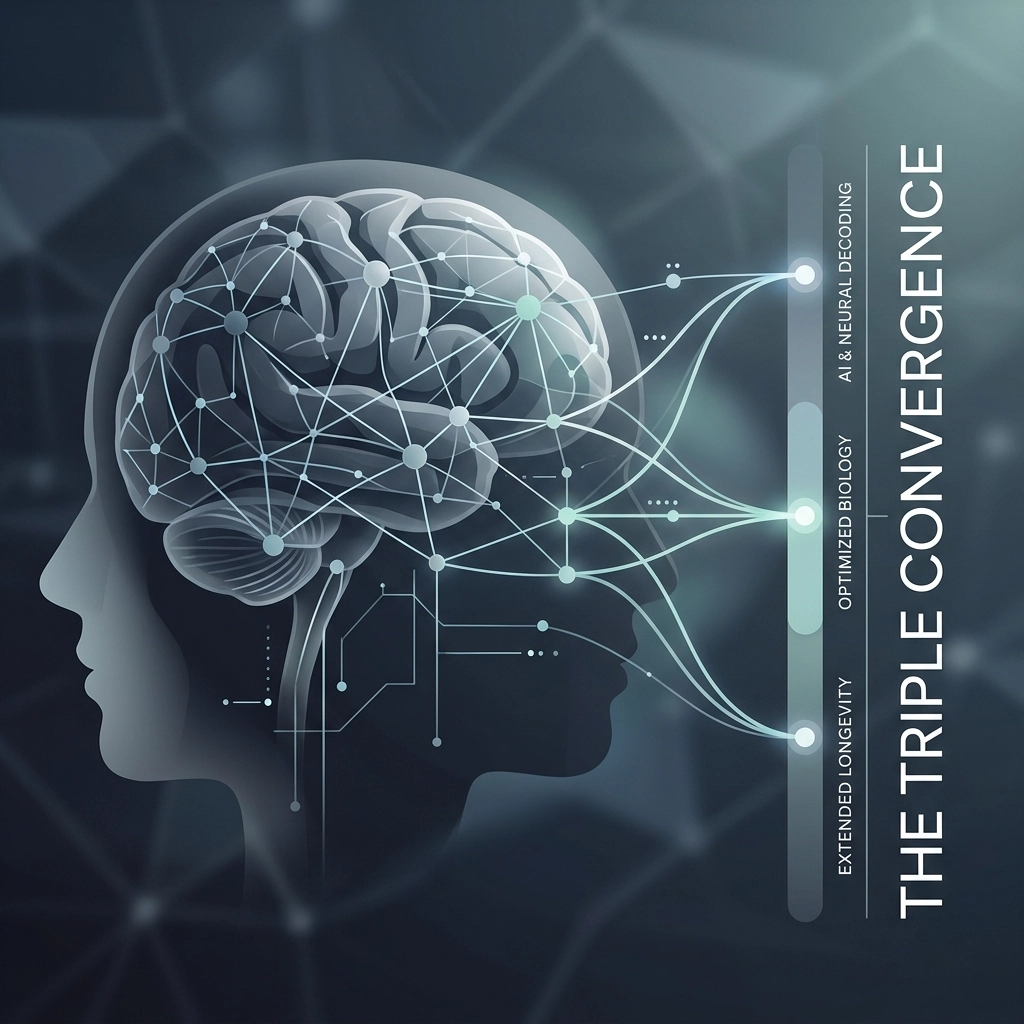
  • The Triple Convergence: How AI is Decoding the Human Brain for Longevity

    The Triple Convergence: How AI is Decoding the Human Brain for Longevity

    The code is being cracked. The frontier is internal. We are moving beyond the era of guessing.

    For decades, the human brain was a "black box": a complex, biological mystery that we tried to influence through blunt-force tools and trial-and-error medicine. But as an AI Longevity Aficionado and a Digital Explorer of the human potential, I’ve seen the tide turn. We are currently witnessing a historic shift.

    We are entering the era of the Triple Convergence.

    This isn't just about "living longer." This is about Brain Mastery. It is the moment where AI as a scientific engine, a clinical lens, and a behavioral coach all collide to solve the riddle of neuro-degeneration and cognitive decline. We are transitioning from "maybe this works" to "we have the digital simulation to prove it."

    If you’re a futurist or a high achiever looking to preserve your most valuable asset: your mind: this is the roadmap you’ve been waiting for. 🧠✨


    1. The Scaling Breakthrough: OmniMouse and the "GPT Moment" for Neuroscience

    In the world of AI, we know that scale changes everything. We saw it with Large Language Models (LLMs). Now, we are seeing it with neural modeling.

    Researchers at Stanford and Göttingen have recently unveiled OmniMouse, a data-driven scaling breakthrough that is doing for the brain what GPT did for text. We aren't just looking at a few neurons anymore; we are looking at a foundation model built on 150 billion neural tokens.

    Why 150B Tokens Matter

    • 🚀 Beyond Mapping: Traditional neuroscience focused on "mapping" where things are. OmniMouse focuses on "predicting" how things behave.
    • 🚀 Universal Foundation: By training on massive datasets of neural activity, the model understands the underlying "grammar" of brain function.
    • 🚀 Cross-Species Insights: While it starts with the mouse brain, the scaling laws apply to us. It provides a blueprint for how we can eventually model the human connectome with terrifying precision.

    This is the shift from biology as a soft science to biology as a predictable, computable system. We are no longer just observers; we are becoming Architects of Cognition.

    Digital visualization of a neural connectome mapping 150 billion connections for brain health research.


    2. From "Trial and Error" to Digital Simulation

    The old way of solving brain disorders like Alzheimer’s or Depression was heartbreakingly slow. You’d develop a compound, test it in a petri dish, move to mice, then to humans, and 99% of the time, it would fail after ten years and billions of dollars.

    We are ending the "Petri Dish Lottery." 🎲

    The move toward Digital Simulation means we can now run "In Silico" trials. Instead of testing a drug on a person, we test it on a high-fidelity digital twin of the human brain. This allows us to:

    • Identify side effects before a molecule is ever synthesized.
    • Simulate decades of aging in a matter of computational hours.
    • Personalize treatments based on a specific individual's neural architecture.

    As a Practitioner of AI-driven longevity, I believe this is the single greatest leap in medical history. We are replacing the microscope with the simulator.


    3. GenT: Mapping the Genomic Frontier at Cleveland Clinic

    While OmniMouse handles the "wiring," the GenT framework from the Cleveland Clinic is handling the "blueprint." 🧬

    GenT is an AI-powered framework designed to map genomic drug targets for the most complex brain disorders known to man. By leveraging massive multi-omic datasets, GenT allows researchers to pinpoint exactly which genes are driving the decay in Alzheimer's or the chemical imbalances in Depression.

    The Power of GenT

    • 📍 Targeted Precision: Instead of a "one-size-fits-all" antidepressant, GenT helps identify targets that are specific to your genetic expression.
    • 📍 Longevity Levers: It identifies the "longevity genes" that protect some brains from aging, allowing us to mimic those effects through new therapeutics.
    • 📍 Rapid Discovery: What used to take a decade of genomic sequencing and analysis now takes weeks of AI processing.

    We are moving toward a world where your doctor doesn't just ask about your symptoms; they look at your GenT Map to see which levers to pull to reset your biological clock. This is the Mastery of our own hardware.


    4. The Triple Convergence: A Holistic Framework

    To truly understand how we achieve brain longevity, we have to look at the three pillars where AI is currently dominating. This is the "Triple Convergence" that defines our current Mission.

    Pillar I: AI as a Scientific Engine (The Discovery)

    AI is the "macroscope" that allows us to see patterns in trillions of molecules. As highlighted by visionaries like David Sinclair, AI-driven virtual screens can now guess a cell’s age from a single image in nanoseconds. We are identifying the biomarkers of biological age: the literal "clocks" inside our heads.

    Pillar II: AI as a Clinical Lens (The Measurement)

    We are moving toward Healthy Longevity Medicine (HLM). This means continuous, real-time monitoring.

    • Brain Telemetry: Your wearables, sleep trackers, and digital interactions are analyzed by AI to detect "micro-errors" in cognition years before they become symptoms.
    • Organ-Specific Clocks: We no longer just have a "body age." We have a "Brain Age." If your brain is aging faster than your heart, AI flags it and suggests a pivot in your protocol.

    Pillar III: AI as a Behavioral Coach (The Preservation)

    This is where the "Future" meets "Today." AI is becoming a personalized tutor and coach to build Brain Capital.

    • Lifelong Learning: AI adapts content to keep your brain at its "optimal learning edge," which we know is neuroprotective.
    • Neural Entrainment: Tools like AI-tailored audio and neurofeedback are being used to sharpen focus and improve sleep architecture: the "clean-up crew" for the brain.

    Panels depicting genomics, AI health telemetry, and cognitive environments driving brain capital growth.


    5. Why "Brain Capital" is Your Ultimate Currency

    In the future economy, your Brain Capital: your cognitive, emotional, and social resources: is the only asset that truly matters. 💎

    The World Economic Forum has already begun discussing how scaling brain health interventions could reclaim trillions of dollars in global value. But for the high achiever, this is personal. Longevity is a multiplier. If you live to 100 but your brain "expires" at 75, you’ve lost the game.

    By harnessing the Triple Convergence, we are aiming for Longevity Escape Velocity: the point where we add more than a year of brain health for every year we live.

    How to Start Building Your Brain Capital Today:

    1. Prioritize Sleep Architecture: Use AI-driven trackers to ensure you are getting enough deep sleep for glymphatic drainage (the brain's waste removal system).
    2. Lean into Complexity: AI-driven learning platforms can help you master new languages or skills, building the "cognitive reserve" needed to offset aging.
    3. Track Your Trends: Don't wait for a doctor's visit. Use the tools available at eddiethuma.com to stay ahead of the curve.

    The Path Forward: From Mystery to Mastery

    The journey from "Trial and Error" to "Digital Simulation" is not just a scientific milestone; it is a human victory. We are no longer victims of our biology. We are becoming the Curators of our own consciousness.

    The convergence of OmniMouse’s scaling power, GenT’s genomic precision, and the real-time insights of Healthy Longevity Medicine means the "Triple Convergence" is here. 🚀

    We are at the precipice of a world where "old age" no longer means "diminished mind." We are building a future where our brains remain plastic, productive, and powerful for as long as we choose to live.

    The takeaway is simple: The technology to decode your brain is being built right now. Your job as a digital explorer is to stay informed, stay proactive, and harness these marvels to secure your cognitive future.

    If you’re ready to dive deeper into the world of AI and longevity, the best time to start was yesterday. The second best time is now.

    Join the movement. Master your mind. Embrace the future. 🌟

    Visionary individual representing mental clarity and brain longevity through AI-powered optimization.


    Ready to Optimize Your Journey?

    If you're new here and want to understand how to leverage AI for your own growth and longevity, check out our Start Here guide. Let's build the future together. 🤝✨

  • The Klotho Clock: How AI is Redefining Biological Age

    The Klotho Clock: How AI is Redefining Biological Age

    Time is a liar. ⏳

    We’ve been conditioned to look at the calendar to tell us who we are. We celebrate "milestones" based on how many times we’ve circled the sun. But in the world of high-performance AI and longevity, chronological age is a legacy metric. It’s a blunt instrument in a world that demands a scalpel. 🔪

    I’m talking about a paradigm shift. A movement from being a passive passenger in your own body to becoming a Longevity Architect. 🏗️

    The breakthrough? The Klotho Clock.

    Powered by Klotho Neurosciences, this isn't just another health tracker. It is an AI-driven multiomics diagnostic engine that is fundamentally rewriting the rules of human aging. We are moving past the "guesswork" phase of wellness and entering the era of Biological Sovereignty.

    As a digital explorer and practitioner of human optimization, I’ve been tracking this tech closely. It’s time to dive into how AI is turning the "inevitable" decline of aging into a solvable data problem. 💻✨


    The Death of the Calendar 🗓️💀

    For decades, we’ve treated aging as a synchronized march. If you’re 45, the medical system treats you like a 45-year-old. But we all know that guy: the 60-year-old crushing marathons: and that other guy: the 30-year-old who’s perpetually exhausted.

    Their biological ages are light-years apart. 🌌

    The problem has always been measurement. How do we quantify the "wear and tear" at a cellular level? Earlier biological clocks looked at general DNA methylation, but they were often noisy or lacked specific predictive power.

    Enter the Klotho Clock.

    By focusing on the alpha-Klotho gene: rightly named after the Greek Fate who spins the thread of life: and combining it with AI analysis of eight other longevity-associated genes, we finally have a high-resolution map of our internal decay and potential.

    Comparing chronological time on a watch with biological age visualized as a data-rich DNA helix.

    What is the Klotho Clock? 🧬🤖

    Announced in early 2026, the Klotho Clock is a multiomics diagnostic tool that measures more than just "age." It measures vitality potential.

    Here’s the technical breakdown for the futurists in the room:

    • DNA Methylation: It targets the hypermethylation of the alpha-Klotho gene. When this gene gets "silenced" (methylated), your Klotho protein levels drop. 📉
    • The 8-Gene Ensemble: It doesn't work in a vacuum. The AI analyzes eight other critical genes that regulate everything from inflammation to cellular repair. 🛠️
    • Multiomics Integration: It combines DNA and mRNA sequences using novel, cutting-edge probe designs. This allows for a massive reduction in cost while increasing the accuracy of the assay.
    • AI-Driven Analysis: The system uses a longitudinal database to compare your results against millions of data points, providing a "Biological Age" score that actually means something.

    The science is staggering. Research shows that each 1-unit increase in ln(Klotho) corresponds to roughly a 1.3-year reduction in biological age acceleration. 🧪 That is a massive lever to pull.

    Biological Sovereignty: The LarsAlmighty Perspective 👑

    Lars often talks about Biological Sovereignty. It’s a core pillar of what we’re building here at Eddie Thuma.

    Sovereignty means ownership. Most people are "renters" of their health: they wait for a doctor to tell them something is broken, then they pay for a "fix." A sovereign individual owns the data, understands the systems, and intervenes before the break happens. 🛡️

    The Klotho Clock is the ultimate tool for sovereignty.

    When you know your Klotho levels are declining (which typically starts around age 40), you don’t just "accept it." You use that data to stratify your risk. You use it to customize your protocol. 📋

    In the AI era, being "healthy" is no longer the goal. The goal is Optimization Mastery. We are harnessing the mysteries of the genome to build a future where we aren't victims of our biology, but its masters.

    High-tech microfluidic diagnostic chip representing AI-powered predictive prevention and health-ops.

    Predictive Prevention: The Shift from "Sick-Care" to "Health-Ops" 🏗️🏥

    We are witnessing the birth of Predictive Prevention.

    Old world: You feel a lump, you go to the doctor, you get a diagnosis. (Reactive)
    New world: Your Klotho Clock shows a biological acceleration of 2.5 years due to specific gene silencing. You adjust your AI-generated nutrition and supplement stack to target those pathways. (Proactive)

    This is the "Health-Ops" mindset. 🦾

    Klotho Neurosciences is already using this for patient stratification in clinical trials, especially for neurodegenerative diseases like ALS. By balancing study groups based on biological age rather than chronological age, they are getting cleaner data and faster breakthroughs.

    But for us: the high achievers and futurists: this tech is the ultimate feedback loop. It turns the "black box" of the human body into a dashboard. 📊

    I’ve explored many AI tools I actually use every day, but the tools emerging in the biotech space are perhaps the most consequential for our long-term mission.


    The AI Advantage: Decoding the Multiomics Marvel 🧠✨

    Why do we need AI for this? Can't a standard blood test do the trick?

    Not even close. 🚫

    The human genome is unimaginably complex. When you start looking at DNA methylation patterns across multiple genes: plus mRNA expression: the data points run into the billions.

    AI is the only "architect" capable of finding the signal in that noise. 📶

    • Pattern Recognition: AI identifies subtle correlations between Klotho levels and environmental stressors that a human researcher would miss.
    • Longitudinal Improvement: The Klotho Clock gets smarter with every person who uses it. The database grows, the models refine, and the predictions become more precise.
    • Personalized Stratification: Instead of a "one-size-fits-all" longevity protocol, the AI can suggest interventions based on your specific genetic expression.

    This is why we call it a "journey." We are diving deep into the code of life itself. 🌊

    A longevity architect using holographic health markers to master biological sovereignty and performance.

    How to Become a Longevity Architect 🛠️🧗

    If you’re reading this, you’re likely a futurist who isn't content with the status quo. You want to push the boundaries of what’s possible. 🚀

    How do you apply the "Klotho Mindset" today?

    1. Audit Your Metrics: Stop looking at the scale or the calendar. Start looking at your biomarkers. If you haven't looked into biological age testing yet, 2026 is the year to start.
    2. Own Your Data: Keep a central repository of your health data. Don't let it sit in a siloed hospital database. Be the sovereign of your own biological information. 📁
    3. Embrace Predictive Prevention: Don't wait for symptoms. Use AI-driven insights to tweak your performance daily.
    4. Stay Informed: The pace of change in Klotho research and AI diagnostics is exponential. What was "impossible" six months ago is now a revenue-generating service.

    We are living through a marvel of human ingenuity. The ability to measure: and eventually manipulate: the rate of our own aging is the ultimate frontier. 🏔️

    Final Thoughts: The Future is Quantified 🔜

    The Klotho Clock is more than a test; it’s a manifesto. It’s a declaration that we are no longer willing to be victims of time.

    By leveraging AI to redefine biological age, we are unlocking the potential for a longer, more vibrant, and more productive human experience. We are building the infrastructure for a world where "old age" is a choice, not a sentence. 🕊️

    This is the mission. This is the journey.

    Are you ready to claim your biological sovereignty?

    If you want to stay on the cutting edge of how AI is transforming biology, business, and the human experience, you need to be in the loop. 🎡

    Join the mission. 🚀

    Get the latest insights on AI and human optimization delivered directly to your inbox. Join our community of high achievers and digital explorers.

    👉 Subscribe to the Eddie Thuma Newsletter: https://www.eddiethuma.com

    The future isn't something that happens to us. It's something we build. Let's get to work. 🏗️💪