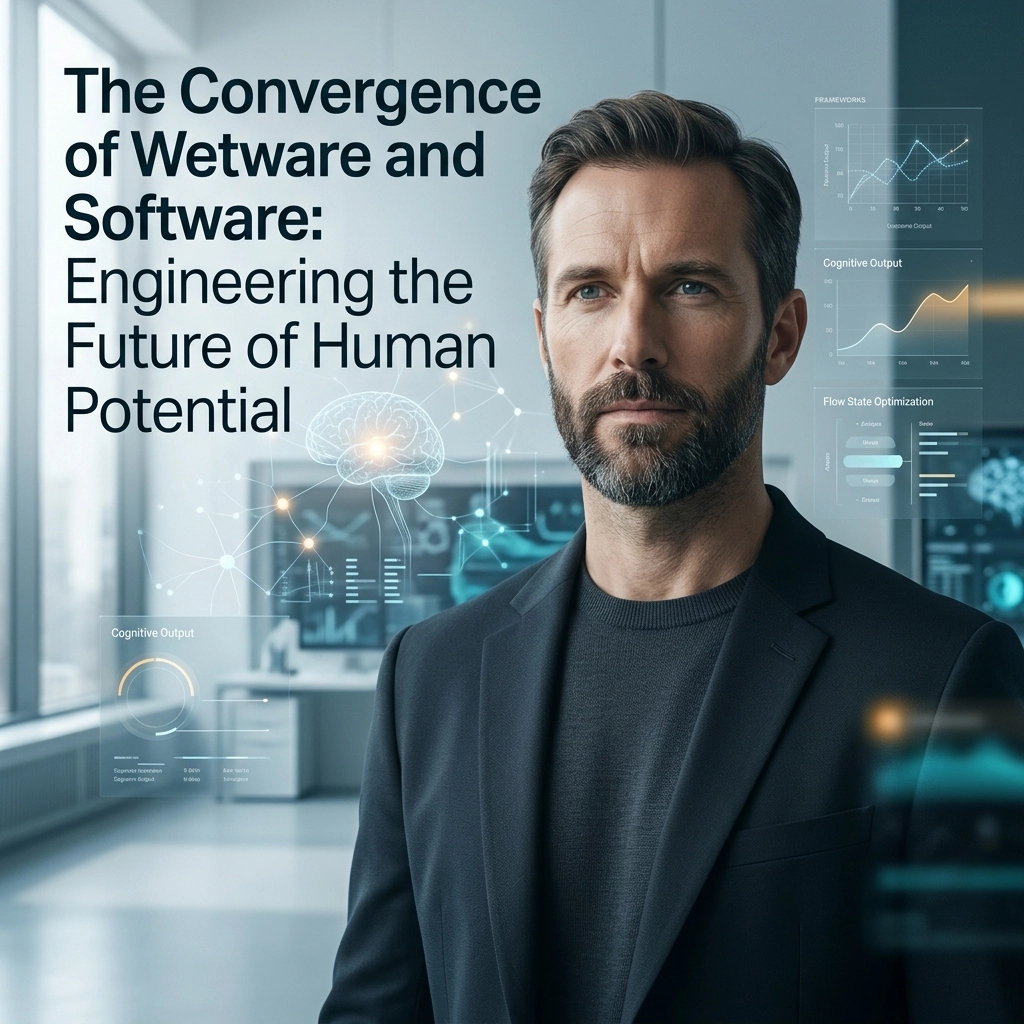
We’ve officially crossed the Rubicon. 🚀
For decades, we’ve treated our brains and our computers as two separate entities: the organic versus the synthetic, the carbon versus the silicon. But as of May 2026, those lines haven’t just blurred; they’ve effectively vanished. We are living through the era of the Convergence.
As a Practitioner of high-performance systems and a dedicated Advocate for human evolution, I’ve spent the last few months diving deep into the labs where the future is being built. What I’ve found isn’t just "cool tech." It’s a fundamental rewrite of what it means to be a high achiever. 🧠✨
We are no longer just users of software. We are becoming the Architects of a unified system where our biological "wetware" and digital "software" operate in a seamless, recursive loop. If you’re a Digital Explorer looking to unlock the next 10x in your personal output, this is the frontier you need to own.
The NeuroSTORM Has Arrived: Decoding the Flow State
If you’ve been following my journey, you know I’m obsessed with flow state on demand. For years, flow was a "feeling": a mystical state that high-performers stumbled into.
That changed this year. Researchers at Stanford recently unveiled 4D fMRI/NeuroSTORM, a breakthrough that allows us to decode the neural signatures of flow in real-time with sub-millimeter precision. 🌩️
Unlike previous imaging that gave us a static "map" of the brain, NeuroSTORM provides a high-fidelity "weather report" of your consciousness. It captures the precise electrical turbulence that occurs when your prefrontal cortex dials down and your subconscious takes the wheel.
The practical takeaway? We are moving toward personalized "Flow Profiles." Imagine an AI tool that monitors your NeuroSTORM data and automatically adjusts your environment: lighting, binaural frequencies, and even the complexity of the tasks in your queue: to force-multiply your focus. This isn't science fiction; it’s the engineering of peak performance.

Living Computers: The Princeton and Northwestern Breakthroughs
While Stanford is decoding the signals, Princeton and Northwestern are rebuilding the hardware.
The team at Princeton just successfully demonstrated 3D bioelectronic computing. They aren't just making faster chips; they are growing living neurons onto silicon substrates to create hybrid processors. This "wetware" is 1,000x more energy-efficient than traditional GPUs because it uses the brain's natural ability to reorganize itself: neuroplasticity: to solve problems. 🧬💻
Simultaneously, Northwestern has cracked the code on 3D-printed artificial neurons. These aren't just plastic models; they are bio-compatible interfaces designed to integrate directly with your central nervous system.
For the modern Architect of potential, this means:
- Reduced Latency: The delay between thought and digital action is approaching zero.
- Adaptive Memory: Systems that don't just store data but "learn" it alongside you.
- Neural Resilience: The ability to offload cognitive heavy lifting to synthetic neural clusters during periods of high stress.
We are shifting from using tools to integrating them. Your next "upgrade" won't be a new laptop; it will be a bioelectronic patch that enhances your native cognitive bandwidth.
MIT and the Biological Fingerprint: FINGERS-7B
One of the greatest fears for any high achiever is cognitive decline. We spend our lives building this incredible mental library, only to worry about it fading.
MIT’s latest release, FINGERS-7B, is the software solution to this wetware problem. By analyzing "biological fingerprints": subtle markers in your speech patterns, micro-movements, and even the NeuroSTORM data mentioned earlier: this AI model can predict and help prevent the earliest signs of Alzheimer’s and other neurodegenerative shifts years before symptoms appear. 🛡️
FINGERS-7B acts as a "Guardian Protocol" for your mind. It’s one of the AI tools I actually use every day to ensure that my most valuable asset: my brain: stays at its peak.
By treating our biology as a data-rich environment, we can apply the same optimization frameworks to our health that we apply to our business systems.

The Architect Mindset: How to Navigate the Convergence
As a Futurist and a Coach, I don’t want you to just read about these marvels. I want you to harness them. The convergence of wetware and software requires a specific mindset shift. You are no longer a passive passenger in your biological body; you are the lead engineer.
1. Own Your Data Substrate 📊
Start tracking your neuro-data. Whether it’s through consumer-grade EEGs or high-end bio-trackers, you need to know your baseline. You can’t optimize what you don't measure.
2. Practice Neuro-Agility 🤸
Use the tools available today to push your neuroplasticity. Use adaptive learning platforms that respond to your stress levels. Engage in "Deep Work" sessions that are timed to your natural circadian rhythms, augmented by AI-driven focus tools.
3. Build for Longevity 🏛️
Think of your brain as a 100-year project. The FINGERS-7B model teaches us that prevention is the ultimate performance hack. Sleep, nutrition, and cognitive load management aren't "soft" skills: they are the maintenance protocols for your wetware.
Part of a resilient maintenance protocol, in my world, also means cellular support. As the energy demand of high-performance wetware increases, I look at mitochondrial health as foundational infrastructure. That’s where Tru Niagen fits into the stack: a simple tool I use to support cellular energy and long-game resilience.
And when it’s time to recover: especially after deep-work sessions that light up the nervous system: I rely on tools like Hooga Red Light Therapy to help me downshift, recover, and stay sustainable. Peak performance is powerful, but durable performance is the real edge.

The Philosophical Shift: From Calculating to Thinking
There is a deep mystery at the heart of this convergence. For a long time, we thought computers calculated and humans thought. But as we integrate living neurons into our processors and AI-driven fingerprints into our healthcare, that distinction is crumbling.
Is a hybrid Princeton processor "thinking"? Is a human with a 3D-printed neural interface merely "calculating"?
The answer doesn't really matter to the Digital Explorer. What matters is the utility. By unifying the adaptability of biology with the precision of software, we are expanding the boundaries of human potential. We are becoming more than the sum of our parts.
This is the most exciting time in human history to be a builder. The mysteries of the mind are becoming the blueprints of the future.
Your Mission Starts Here
If you feel the pull toward this new frontier, don't just sit on the sidelines. The convergence is happening with or without your permission. The question is: will you be the one being programmed, or will you be the one doing the programming?
For those ready to dive deeper into the frameworks of the future, start here to get your foundation solid. 🏗️
The future isn't something that happens to us. It’s something we engineer. Let’s build it together.
Stay curious. Stay disciplined. Stay visionary.
: Eddie Thuma
Join the Newsletter 🚀
Ready to join the elite group of Futurists engineering the next leap in human potential?
Join my inner circle for weekly insights on AI, neuroscience, and the tools that actually matter. No fluff, just the blueprints you need to win.
Leave a Reply